
The resurgence of Wrexham FC (Clwb Peldroed Wrecsam) since 2021 has been well documented and has attracted considerable media attention in England, Wales, the USA, and many other countries.
Personal Enthusiasm
The dynamic, hands-on entrepreneurial duo of Ryan Reynolds and Rob McElhenny, alongside a managerial structure led by Phil Parkinson, has restored Wrexham AFC to the Championship and has boosted the city’s economic and cultural life. In the recently published There’s Something About Wrexham: Great Stories From Some of Wrexham AFC’s Biggest Names, ardent supporters Deio Edwards and Iestyn Jones share their club knowledge, links with players, and personal enthusiasm to unravel, with 20 Wrexham AFC legends, their anecdotal experiences during the period described as “the chaos” before Ryan and Rob “came to town”.
In many ways, the player anecdotes highlight the prevailing warmth in the dressing room during a period of managerial turmoil, on and off the field. Readers may well reflect on player comments concerning the impact of late wage payments on the team during the Geoff Moss era, and ponder other prevailing issues, such as the construction of the University halls of residence, which ended up encroaching on the Kop.
Leadership Skills
The anecdotal stories highlight the leadership skills of Brian Carey, Darren Ferguson, Gareth Davies, John Neal and Kevin Russell. The reflections of some players in the group of 20 highlight, unignorably, the outstanding influence of the indomitable Joey Jones, particularly for his motivational, coaching, and supportive skills.
For the many thousands who attended the memorial at STōK Cae Ras following Joey’s death, the stories will rekindle emotional recollections of a player, coach and mentor full of humour, commitment, warmth and kindness, who gave his all for the club.
Gareth Owen reflects on the 1990-91 season, when young players such as Waynne Phillips, Phil Hardy and Steve Watkins played alongside experienced players such as Jones, Mel Pejic and Tony Hume. Again, it is clear that Joey was a standout coach/mentor for so many. Gareth highlights the qualities of Jones as a mentor not only for him but for the whole family within Wrexham AFC.

“Blew His Top”
Andrew Morrell recalls Joey emphasising that “your attitude and application are what define you as a person”. The praise for Jones is substantiated in a recollection by Lee Jones of Joey confronting Jon Bowden, the club captain, as he “blew his top” at the young players’ performances. Joey’s actions will bring a knowing smile to many readers’ faces.
Ian Edwards’ recollections of playing in the old Second Division (now the Championship) will enable older supporters to tap into their long-term memories of stalwarts such as Dai Davies, Dixie McNeil, Steve Buxton, Arfon Griffiths, David Gaskell, Billy Ashcroft, Mickey Thomas, and others. Billy Ashcroft highlights this period when he was on £19 a week as a first-year pro under manager John Neal. Those were the days of pre-season training in Aberystwyth and circuit training on the sand dunes at Ynyslas.
He recalls the “glory days” playing against FC Zurich in the European Cup Winners competition in 1972 and then Anderlecht away. Those were the days when supporters thronged to see the skills of players such as Gareth Davies, Graham Whittle, Mel Sutton and Thomas.
Overabundance of Expletives
Locals will enjoy the recollections of Andy Edwards, a product of the Queens Park Youth Club, about the good advice he received on self-protection from Dixie McNeil. At the same time, Neil Roberts from Garden Village highlights Brian Flynn’s managerial skills.
Unfortunately, in terms of the quality of the text, the overabundance of expletives, in particular the frequent use of the “F” word in capitals, severely detracts from the value of the book. At times, the authors’ use of extreme expletives is unjustified and diminishes the book’s value.
Some readers may consider the overuse and emphasis given to the “F” word and lack of effective editing reduce some contributions to the gutter press, highlighting a lack of awareness by the authors of the fine line between public and private use of expletives and the importance of acceptability.
Insightful Evidence
In many ways, Edwards and Jones have compiled a range of insights into the highs and lows of the club from players’ perspectives. Some experienced magical moments, played alongside outstanding personalities, and won great victories, inspiring and enthusing supporters. However, in common with the experience of other clubs, the success was followed by chaos resulting from self-inflicted problems, lack of genuine leadership and managerial blunders.
Despite some insightful evidence from the likes of Gareth Owen, Waynne Phillips, Lee Jones, Andrew Morrell and Billy Ashcroft, the authors have missed the opportunity to coordinate and edit the contributions effectively for a potentially broad audience. In footballing parlance,“the build-up play was often good and promised much, but they failed to put the ball in the back of the net.”
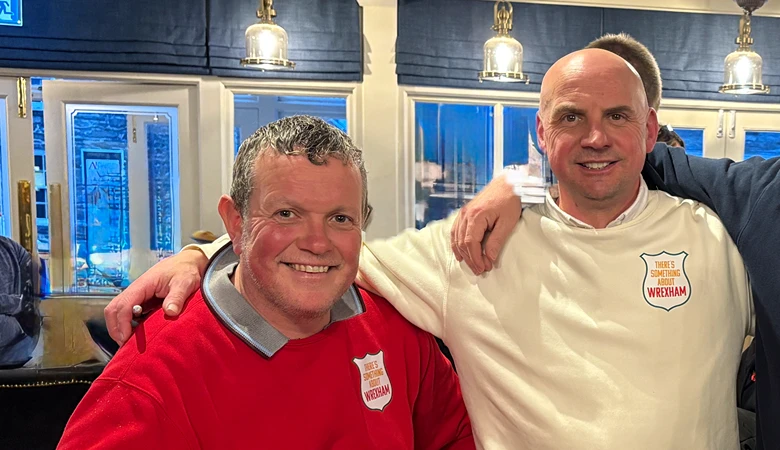
Feature image: Deio Edwards and Iestyn Jones.
We hope you enjoyed reading “Wrexham AFC Before The Takeover”. Click here for more of John’s book reviews.

Author: John Morris for Love Wrexham Magazine
John is an FA coach. He has worked with young players at Fulham, Chelsea, QPR and Wrexham, promoting resilience, tenacity and self-discipline. He is currently a consultant addressing growth mindsets to promote sports, education, and business performance.
