
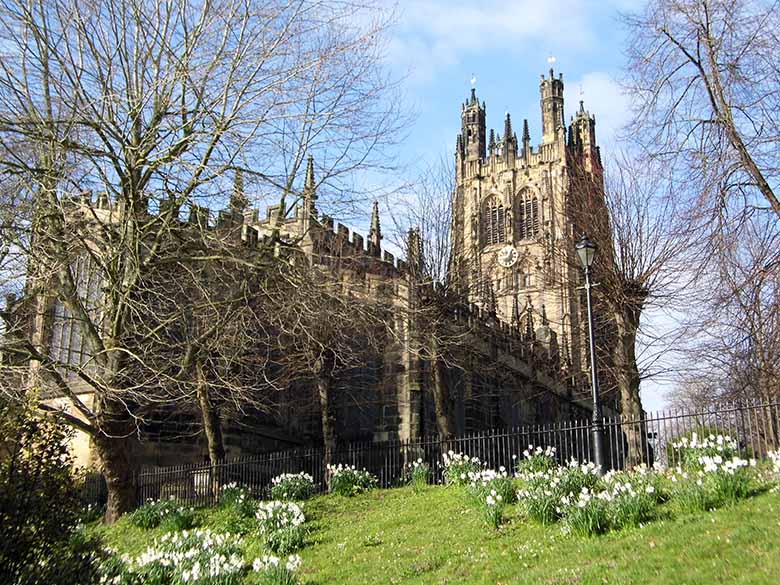
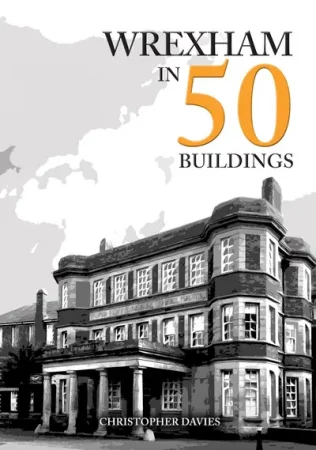
Local history once sat in the shadow of a British or southern-English narrative, leaving many in Wales with little sense of their own industrial and cultural past. Christopher Davies’ Wrexham in 50 Buildings sets out to redress that, using 50 key buildings to illuminate the story of a town that became a city in 2022.
A Rich Architectural Record
Davies, an experienced local historian, selects 50 buildings that chart Wrexham’s rise as an industrial, commercial and cultural centre. His introduction sets out a heritage rooted in coal, iron, steel, brick, leather and brewing, alongside the area’s role in agriculture and food. It is a confident framing of the wider North Wales hinterland that the town long served.
The photography is the book’s great strength, and the narrative adds valuable historical detail throughout. Davies is especially good on how buildings have changed use over time. The former Soames brewery, now converted into residential apartments, is a telling example.
Many local readers will find their own memories sparked by the images. Some may even hold treasured photographs or artefacts that extend the record further. In this respect, the book works as a reference and keepsake.
Where the Story Stops Short
For all its merits, the book says little about how this historical base shaped the Wrexham of today, and the link between the chosen buildings and the city’s newer identity is rarely drawn, with employment, sport, culture and language left largely unexplored.
Wrexham now hosts one of Europe’s largest industrial estates, home to employers such as Kellogg’s and JCB. A growing, increasingly cosmopolitan population has followed. Yet these markers of a thriving modern economy find little place in the selection.
The omission of Wrexham AFC is harder still to explain. The club’s headline success has drawn capacity crowds and sharpened the commercial and media flair of its directors. It has lifted the city’s profile and, indirectly, its appeal as a place to work, visit and live.
A Living, Bilingual City
The same gap shows in the treatment of social and cultural change. The 21st-century revival of the Welsh language is a striking example. Wrexham Borough now has seven Welsh-medium primary schools, four of them in the town.
The secondary school Ysgol Morgan Llwyd, on the former Coleg Cartrefle site, thrives with its own sixth-form centre. Older readers will recall that, before the 1960s, the borough had no Welsh-medium schools at all. Many of their families had arrived from the Welsh-speaking quarrying districts in search of work and housing.
Bilingualism now reaches well beyond the classroom, not least at Wrexham AFC, whose ground was named STōK Cae Ras and used signs in two languages. None of this diminishes a handsome, well-researched book that many will enjoy. It simply leaves room for a fuller account of how the past made the present, and on that basis, it remains well worth reading.
We hope you enjoyed reading “A Handsome History of Wrexham’s Transformation“. Click here for more of our book reviews.

Author: John Morris for Love Wrexham Magazine
John is an FA coach. He has worked with young players at Fulham, Chelsea, QPR and Wrexham, promoting resilience, tenacity and self-discipline. He is currently a consultant addressing growth mindsets to promote sports, education, and business performance.
